A very interesting new carabineer from Grivel - Stevie Haston certainly makes it look effortless to use, but it would be interesting to see if it still looks so easy in the middle of a desperate onsight attempt.

3 September 2014
Grivel Twin Gate carabiner
A very interesting new carabineer from Grivel - Stevie Haston certainly makes it look effortless to use, but it would be interesting to see if it still looks so easy in the middle of a desperate onsight attempt.

30 September 2013
Black Diamond testing lab: Acid damage to climbing gear
Kolin Powick has added another excellent article to the Black Diamond QC Lab blog about acid damage to climbing gear. He received an email from a climber whose harness had inexplicably failed while being lowered on a top rope. It turned out the harness had been exposed to an acid - an interesting tell-tale sign is discolouration in the stitching of the waist loop. Otherwise the harness looked in generally reasonable condition, but the stitching had turned pink/red as opposed to the normal grey colour.

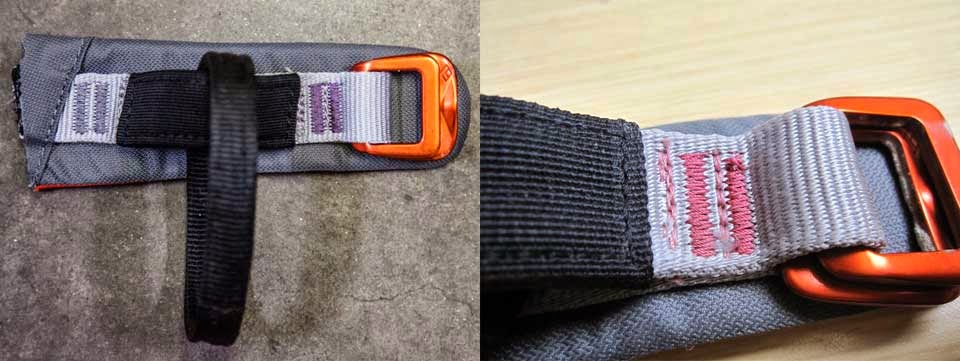
The left hand harness has been exposed to a household product containing hydrochloric acid, and sulphuric acid on the right. Image from Black Diamond
Kolin tests the effect of about a dozen different household goods on the strength of a harness. Some are catastrophic, some have little effect - but it's not always obvious which will cause damage and which won't.
20 July 2013
New DMM gear: Thor carabiner with 11kN open gate strength, Rhino belay carabiner with 'horn'
DMM have announced a few new products at the OutDoor Friedrichshafen trade show in Germany. First, the Thor carabiner - a crab with 11 kN open gate strength and extra material in the high wear areas (where the rope runs and the bolt or gear touches). It weighs in at 36g, so a touch heavier than the Spectre 2 (33g) or Alpha Trad (34g). Although ideally the gate should stay closed when climbing, some may find it reassuring for their carabiners to be strong enough to hold a large fall even if the gate were to come open.

Another new carabiner is the Rhino belay screwgate. This interesting looking crab has a 'horn' which they say "prevents assisted locking belay devices rotating off the top bar and on to the spine reducing the risk of cross loading, it also works well with selected DMM pulleys".


Image from DMM
Another new carabiner is the Rhino belay screwgate. This interesting looking crab has a 'horn' which they say "prevents assisted locking belay devices rotating off the top bar and on to the spine reducing the risk of cross loading, it also works well with selected DMM pulleys".

Image from DMM
15 June 2013
Load testing real trad gear placements
Michael Law has tested a collection of trad gear placements to see how solid 'real' placements are in real rock. He used a hydraulic piston to pull each placement until failure. Some of the results are quite surprising - with some very marginal looking placements taking surprising loads. He tests Camp Double nuts, a Wild Country Hex, an HB Quad Cam, a Camp Tricam, and a tied off chicken head.
This extremely marginal looking hex took around 14kN before failing:


This extremely marginal looking hex took around 14kN before failing:


Images from http://www.sanguma.org/destructo/result2.php
2 June 2013
The anti cam by Matt Maddaloni - cam for large detached flakes
Matt Maddaloni designed and built an ingenious anti-cam in 2010. The anti-cam is designed to attach to large flakes by gripping to only the two sides of the flake itself (as opposed to the inside of the flake and wall). He documents some of the process on the rockclimbing forums

Image from Matt Maddaloni on rockclimbing forums
There's also some vimeo clips of the process and of the antic-cam in use:
The Season Episode 9 from Duct Tape Then Beer on Vimeo.
The Season Episode 15 from Duct Tape Then Beer on Vimeo.
Other parts: http://vimeo.com/11641154 and http://vimeo.com/11745783
20 April 2013
Black Diamond: the dangers of modifying climbing hardwear
It's not surprising to hear a manufacturer asking its users not to modify their climbing hardware, but it is interesting to hear why. Black Diamond have written an interesting article about the various modifications that they are often asked about; re-slinging cams with extender slings, using a screamer between you and your ice axes to hold a fall, swapping the bails on your crampons. They carried out tests on each of these - and generally the result is not ideal; with failures at relatively low loads.


13 April 2013
Edelrid Mirco Jul and Mega Jul belay devices
An interesting new pair of belay devices from Edelrid - the Micro Jul (for narrow ropes) and Mega Jul are assisted braking device which can also be used in 'guide mode' where two seconds can be brought up at the same time. It looks like there's a fairly easy way to lower fallen seconds when on guide mode too. It appears to be similar to the Mammut Smart in the way its assisted braking works, so it will be interesting to see if it also suffers from the awkward rope-feeding.
EDELRID Micro Jul & Mega Jul EN from EDELRID on Vimeo.
3 March 2013
Petzl Laser Speed Light ice screw
One of the more interesting of Petzl's latest product announcements is the Petzl Laser Light Speed ice screw - a screw with an aluminium main body and a steel tip. It weighs 100g (for a 17cm screw) and has a folding handle. The older Laser Sonic weighs 185g for a 17cm screw, while a Black DIamond Express weighs 145g even with a slightly shorter length at 16cm. I would be interested to see exactly how they have made the connection between the two types of metal, because seamlessly joining steel and aluminium has in the past been a bit of an engineering challenge.


Image from UKC
5 January 2013
1972 Chouinard Equipment Catalogue
A fascinating piece of history: the 1972 Chouinard Catalogue has all kinds of interesting snippets and historical info.


Cover of the 1972 Chouinard Catalogue (image from Black Diamond)
The history part of the Patagonia website is also very interesting.
9 December 2012
Rope innovation: Mammut Sensor, Edelrid Snipe, Beal Unicore
There several interesting developments coming over the next year. The Mammut Sensor has middle and end markings which you can feel with your grip as well as see. According to this article at the Gear Caster, Mammut uses thicker yarn on these identifier sections.


Beals Unicore ropes basically have the sheath glued to the core. They say this prevents slippage when the sheath is cut or abraded, reduces shrinkage due to water submersion, and allows the rope to be cut to length without a heated knife. Preventing sheath slippage is particularly useful when ascending - normally if a sheath is damaged on a fixed line it can make it difficult or impossible to ascend, Unicore aims to reduce this. There's more info on the Beal website.


The Edelrid Snipe has a larger 10mm diameter near its ends (7m on each end) so that you can feel when the ends are approaching. It also means that the ends should be a bit more hard wearing - which is clever because that's the bit which usually wears out first.

There's also a interesting idea coming from Beal - related to the Unicore technology; that if rope is more slick and supple, it affects the ease of use and handling more than simply reducing weight and diameter. The BMC suggests this may mean we'll see a change in the trend towards thinner and thinner ropes.
1 September 2012
Sirocco helmet from Petzl
The new Sirocco helmet from Petzl is moulded from expanded polypropylene EPP (as opposed to the more usual expanded polystyrene EPS) which has enabled them to create the helmet as a 'monobloc'. That is, it is formed as a single component rather than the usual layered structure of an EPS foam inner with a polycarbonate shell. It is superlight at 165g (for comparison the Petzl Meteor III weighs 235g and is one of the lightest helmets currently available). It also has a very nifty looking magnetic buckle - which they say you can clip with one hand. Here's a video from UKC at the Outdoor Show 2012:
31 August 2012
Choosing the right carabiner
Black Diamond director of quality, Kolin Powick, has written a great article on carabiners; it talks about rock climbing crabs vs industrial crabs and why they don't recommend using one type for the other activity. He also carried out some tests on 'workhorse' crabs vs lightweight crabs using a drop tower. It's interesting to see that the lightweight crabs actually tended to deform and become unusable, whereas in the same tests the heavy duty crabs remained usable.
 Image from Black Diamond

19 July 2012
New cam from Black Diamond: X4
Black Diamond have revealed a new 'large expansion range' small cam family called the X4. The most interesting part is the axle - which is offset. That is, the axle protrudes from a different place on each side of the cam hub. This is probably best explained in this video from UKC:
22 June 2012
Making furniture out of climbing rope: Seilfaktur
Seilfaktur is a Design Project created by Angelika Hess - creating furniture out of spent climbing ropes. Apparently she is based in Rosenheim near the Alps - and decided to create this furniture after wondering what happens to all the ropes after they can no longer can be used.
More at Core77 and Inhabitat or at the creators website: http://seilfaktur.de/


More at Core77 and Inhabitat or at the creators website: http://seilfaktur.de/

Images from http://seilfaktur.de/
17 June 2012
How long do slings and quickdraws last?
Another interesting article from the Black Diamond Quality Control Lab - this time looking at slings and quickdraws. They used a bunch of different sling materials and did some pull tests to see how strong they were after they had been abraded, and also how strong they were after being loaded to 5kN 1000 times (to simulate in-situ gear that's taken a lot of falls), and 11kN cycled until failure.

They also mention that one previous finding was that int-situ slings seem to loose most strength in the first 10 weeks of being exposed - although this finding didn't agree some some other results.
Image from Black Diamond
Those slings that made it through the abrasion test didn't actually loose that much strength in general, but some slings broke during the abrasion cycling. Loading to 5kN 1000 times seemed to have almost no influence on strength, loading to 11kN produced unpredictable results.
They also mention that one previous finding was that int-situ slings seem to loose most strength in the first 10 weeks of being exposed - although this finding didn't agree some some other results.
10 June 2012
Metolius Master Cam failure - cam stop broken
Count Chockula in the mountinaproject.com forums writes: "This #0 rarely gets placed and has never been hung on or taken a single fall, but one of the cam stops has completely sheared off the lobe." The post is old (May 2011) but interesting. Metolious replaced the cam and have apparently made changes to the design since then.


In an apparently separate incident, another forum user Alan Ream shows a photo of his Master Cam, which also has broken cam stops. He shows it side by side with the newer design of stops - which appear to be slightly larger and no longer adjacent to grooves in the camming surface. Users speculated that the proximity of the stops to the grooves could have contributed to the failures.

Image from
Alan Ream on mountainproject.com forums
1 June 2012
Unusual carabiners: Rock Exotica Bi-wire, Petzl Ange, Kong Ergo Wire
I haven't used any of these, but they all look interesting. The Rock Exotica Bi-Wire is strong (30, 10, 9 kN), heavy (67g), but most unusually - it has two gates. The inner gate opens inwardly and the outer gate opens outwardly. It looks like it might take some getting used to clipping it, and wouldn't really be suitable for use in a quickdraw, maybe as a more secure clip to an anchor?

Next is a Petzl Ange, which has been out since last year but doesn't seem to be widely distributed in UK stores. It has a single pronged wire gate (they call it a Monofil) rather than the normal 'looped' wire gate which means it's quite light (28g). For me, I like the idea of a single prong because it cant get tangled up like a normal wire gate - when carrying a full rack I've sometimes found wires from nuts, or the wire gate from another carabiner, can get jammed quite badly in between the nose of a wire gate carabiner. This is very difficult to solve when hanging on with one hand, and can make it impossible to place any nuts because it completely disables the gate.

Last is the Kong Ergo Wire which has an 'ergonomic' plastic grip on the wire and a via ferreta style locking device.
 Imamge from Kong

Image from CMC Rescue
Next is a Petzl Ange, which has been out since last year but doesn't seem to be widely distributed in UK stores. It has a single pronged wire gate (they call it a Monofil) rather than the normal 'looped' wire gate which means it's quite light (28g). For me, I like the idea of a single prong because it cant get tangled up like a normal wire gate - when carrying a full rack I've sometimes found wires from nuts, or the wire gate from another carabiner, can get jammed quite badly in between the nose of a wire gate carabiner. This is very difficult to solve when hanging on with one hand, and can make it impossible to place any nuts because it completely disables the gate.

Image from Petzl

26 May 2012
Crampons: do they break?
Black Diamond have posted an excellent article on crampons - it talks about choosing materials, eg. stainless steel vs chromoly steel vs aluminium, and about fatigue testing, and selecting the right crampons for your boot and your activity.
A few years ago they started using stainless steel instead of chromoly steel. Both chromoly and stainless contain chromium as an alloying element, but chromoly contains less than 1% chromium, whereas stainless steel contains at least 10.5%. This means that chromoly rusts more easily than stainless. There are also other material property differences. Ultimately they decided that stainless was better suited to the task as they found it was more wear resistant, didn't pick up as much snow when walking, and didn't rust as much.
They also refer to a BMC leaflet about care and mainteneance - the interesting point which is confirmed by their tests, is that if you have flexible boots you should wear flexible crampons, and stiff crampons for stiff boots. In their tests the fatigue life of crampons was reduced by roughly up to 80% when there was a mismatch between crampons and boots. If you have soft boots make sure you replace those rigid steel cross bars in your crampons with a flexible one, it could increase the lifespan of your crampons considerably!
 Image from Black Diamond article
A few years ago they started using stainless steel instead of chromoly steel. Both chromoly and stainless contain chromium as an alloying element, but chromoly contains less than 1% chromium, whereas stainless steel contains at least 10.5%. This means that chromoly rusts more easily than stainless. There are also other material property differences. Ultimately they decided that stainless was better suited to the task as they found it was more wear resistant, didn't pick up as much snow when walking, and didn't rust as much.
They also refer to a BMC leaflet about care and mainteneance - the interesting point which is confirmed by their tests, is that if you have flexible boots you should wear flexible crampons, and stiff crampons for stiff boots. In their tests the fatigue life of crampons was reduced by roughly up to 80% when there was a mismatch between crampons and boots. If you have soft boots make sure you replace those rigid steel cross bars in your crampons with a flexible one, it could increase the lifespan of your crampons considerably!
20 May 2012
Are knotted Dyneema® slings good for climbing?
DMM have carried out some very interesting static load and drop-tower tests to find out the strength of knotted Dyneema® slings. Dyneema® is normally found in stitched slings - DMM wanted to find out how slings would fare if made by tying your own knot in a piece of Dyneema® from a reel.
As the DMM article mentions, Dyneema® is actually just a brand name for Ultra-high-molecular-weight polyethylene (wikipedia) which is a type of polythene (wikipedia) which has very long molecules, which makes it stronger and tougher than polythene with shorter chained molecules. The size of the molecules is key because polythene with shorter molecules will have massively different mechanical properties.
Dyneema® also has a relatively low melting point (between 144 and 152C) and also has a 'low' coefficient of friction. DMM suggests that heat in the knot during dynamic testing could explain why the knotted sling failed at significantly lower loads than the sewn slings. DMM believes this is supported by the result that frozen and wet knotted slings were stronger than dry ones - perhaps suggesting that the water/ice in the knot helps to reduce heat build up.
Based on the results of the tests, DMM strongly recommend against using knotted Dyneema® slings as they consistently failed at lower loads compared to sewn counterparts.
Take a look at the full article here. The video gives a good overview.

Image from DMM article
12 May 2012
Bosavi headlamp on kickstarter
Bosavi is a nifty looking headlamp featured on the kickstarter fundraising website, it is rechargeable with a lithium battery. It appears to be similar in a lot of ways to the Petzl Tikka headlamps when used with a rechargeable Core battery, but there a few interesting differences. It is smaller and lighter than the Tikka XP2 with a Core battery (the most comparable Petzl lamp), the packaging for the lamp is designed to turn into an origami lantern, and it has a bike adapter for fitting to a bicycle handlebar.
It has very similar lighting modes (red light for night vision, diffuse white light, two levels of high brightness spot light, strobe safety light, and a high intensity 110 lumen boost mode) to the Tikka XP2, similar brightness on the normal mode (both 60 lumen), similar battery life (70 hours on low setting for Bosavi, ~80 hours for Tikka XP2 on low).
So far it is fairing well on kickstarter - as of 12 May 2012, after around 10 days it has raised roughly $18,000 of its $20,000 target, and there is still 35 days to go. It seems a given that it will raise its target - and quite likely that it will raise significantly more. The minimum amount you need to pay in order to receive one of the lamps is $65 (+$15 for international shipping). It is also likely that UK residents will pay significant import/postal costs, in the past I have been charged £20 for an $80 item from the US.
Video from Bosavi kickstarter page
Subscribe to:
Posts (Atom)